
odrbob.com
Diet - Create/Modify Your Plan
| THIS PAGE IS UNDER CONSTRUCTION PLEASE COME BACK SOON |
Basic Diet Information
You really are what you eat. Every bit of substance-solid, liquid or gas- you put into your body accounts for some "net" change
in your biochemistry. While some people are extremely lucky, others make good choices and benefit from the science of diet.
These short essays should help you define or modify your plan to use diet as a tool to enhance and sustain health and well
being. Life can easily be mastered when you understand fully one of the main Laws of the Universe. Namely, For every action,
there is an equal, opposite re-action. Whatever substance you put into your system, it will definitely cost the body some energy
as it is being broken down and absorbed, but there should be a net gain of materials to produce more energy for living and
more maintenance of the cells and, ultimately, the bodies' parts. Lastly, there should be the least amount of metabolic waste
created because it takes a lot of energy to store it or remove it. And, an accumulation over time could change the pH which
then could cause premature degeneration, aging or harm.
When constructing your diet keep in mind what your goals and timing are. You must factor in: genetics, present condition, age,
height, weight, occupation, types and amounts of activities and disposition. Consider the following:
Genetics: Do you have any specific disorders or compromises when it comes to the body and its metabolism?
Condition: What is your current health status? Problems? Recovering from something? Capable of proceeding?
Age: Are you too old or too young? Are you realistic about your approach or goal? Do you have the time?
Height: Size can change your posture and abilities. Are you straight up & down or twisted and slumped?
Weight: Are you trying to gain weight? Are you trying to lose weight? Are you just maintaining?
Job Type: The type of work effort needs to be met by increases or decreases in consumption of food and supplements.
Activities: Do you exercise? Do you stretch? Do you have movement in your life? How much do you need to do?
Disposition: What is in your head? How do you look at life? Are you relaxed? Are you stressed? Are you interested?
You really are what you eat. Every bit of substance-solid, liquid or gas- you put into your body accounts for some "net" change
in your biochemistry. While some people are extremely lucky, others make good choices and benefit from the science of diet.
These short essays should help you define or modify your plan to use diet as a tool to enhance and sustain health and well
being. Life can easily be mastered when you understand fully one of the main Laws of the Universe. Namely, For every action,
there is an equal, opposite re-action. Whatever substance you put into your system, it will definitely cost the body some energy
as it is being broken down and absorbed, but there should be a net gain of materials to produce more energy for living and
more maintenance of the cells and, ultimately, the bodies' parts. Lastly, there should be the least amount of metabolic waste
created because it takes a lot of energy to store it or remove it. And, an accumulation over time could change the pH which
then could cause premature degeneration, aging or harm.
When constructing your diet keep in mind what your goals and timing are. You must factor in: genetics, present condition, age,
height, weight, occupation, types and amounts of activities and disposition. Consider the following:
Genetics: Do you have any specific disorders or compromises when it comes to the body and its metabolism?
Condition: What is your current health status? Problems? Recovering from something? Capable of proceeding?
Age: Are you too old or too young? Are you realistic about your approach or goal? Do you have the time?
Height: Size can change your posture and abilities. Are you straight up & down or twisted and slumped?
Weight: Are you trying to gain weight? Are you trying to lose weight? Are you just maintaining?
Job Type: The type of work effort needs to be met by increases or decreases in consumption of food and supplements.
Activities: Do you exercise? Do you stretch? Do you have movement in your life? How much do you need to do?
Disposition: What is in your head? How do you look at life? Are you relaxed? Are you stressed? Are you interested?
Infants:
Children:
Teens:
Young Adults:
Mid-Aged Adults:
Seniors:
Children:
Teens:
Young Adults:
Mid-Aged Adults:
Seniors:
0-12 months
1-12 years
13-19 years
20-35 years
35-55 years
over 55 years
1-12 years
13-19 years
20-35 years
35-55 years
over 55 years
Development & Immunity
Mobilization & Co-ordination
Strength & Mentation
Growth and Repair
Maintenance & Repair
Repair and Pace
Mobilization & Co-ordination
Strength & Mentation
Growth and Repair
Maintenance & Repair
Repair and Pace
Main Focus for Health/Longevity
Age Specific
Constructing A Diet
Types of Food/Diet
Supplementation Needs
Breast Milk/Slow solids
Modified Zone
Zone
Zone plus Glycemic
Zone and Vegetarian
Vegetarian
Modified Zone
Zone
Zone plus Glycemic
Zone and Vegetarian
Vegetarian
Generally NO - Colostrum
Children's Multi or Specialty
Teen's Specific Formulas
Daily & Anti-oxidants & Repair
Daily & Anti-oxidants & Repair
Daily & Anti-oxidants & Repair
Children's Multi or Specialty
Teen's Specific Formulas
Daily & Anti-oxidants & Repair
Daily & Anti-oxidants & Repair
Daily & Anti-oxidants & Repair
Infants:
Children:
Teens:
Young Adults:
Mid-Aged Adults:
Seniors:
Children:
Teens:
Young Adults:
Mid-Aged Adults:
Seniors:
Mother's milk; colostrum; slow intro to grains, fruit & vegetables; avoid animal fat; hydrate
0-12 months
1-12 years
13-19 years
20-35 years
35-55 years
over 55 years
1-12 years
13-19 years
20-35 years
35-55 years
over 55 years
Vegetables; fruit; whole grains; small amounts of animal protein & fat; hydrate
Vegetables; fruit; whole grains; small amounts of animal protein & fat; hydrate
Vegetables; fruit; whole grains; small amounts of animal protein & fat; hydrate
Vegetables; fruit; whole grains; limited amounts of animal protein & fat; hydrate
Vegetables; fruit; whole grains; almost no animal protein or fat; hydrate

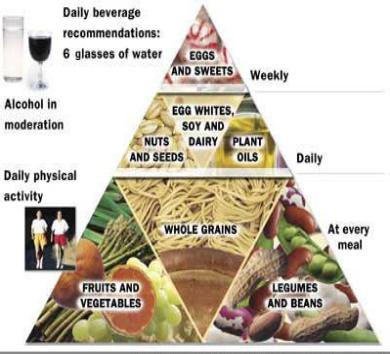
You are here: Home / Inside the Pyramid
Inside The Pyramid
Related Topics
Grains
Vegetables
Fruits
Milk
Meat & Poultry
Legumes & Nuts
Oils/Fats
Discretionary Calories
Physical Activity
Vegetarian Pyramid
Weight 101
You need to eat food and drink beverages and add herbs and supplements to sustain your life. The body derives elemental
components from these substances and utilizes them to build all of the structures in the body. It also uses them as the basis or
compliment of body chemistry, which becomes the fuel substance that drives all parts of the cell.
At the end of the day one will have consumed a specific amount of all substances. And at the end of that time period, one will
have had a sum total of physical expenditures of energy. At the end of those cycles the body will weigh a certain number of
kilograms or pounds. If all factors of substance in and energy out remains the same, the presumption is, the body weight will be
the same.
If however, one consumes more food without changing any of the physical use aspects, the assumption must be that there will
be weight gain.
If one lessens the consumption of food without changing the previous activity level, you can expect to lose some weight.
If one doesn't change consumption but does increase activity, there will be an overall reduction in weight as the body burns
stored fuels.
If there is no change in the diet, but one lessens the activity levels, then one could expect a gain in weight.
Diet is the means of controlling the quantity and quality of substances entering the body to achieve the desired level of health,
including weight.
Disease or organ dysfunction, especially, the thyroid, pancreas and small intestine can alter the results of dietary experience.
You need to eat food and drink beverages and add herbs and supplements to sustain your life. The body derives elemental
components from these substances and utilizes them to build all of the structures in the body. It also uses them as the basis or
compliment of body chemistry, which becomes the fuel substance that drives all parts of the cell.
At the end of the day one will have consumed a specific amount of all substances. And at the end of that time period, one will
have had a sum total of physical expenditures of energy. At the end of those cycles the body will weigh a certain number of
kilograms or pounds. If all factors of substance in and energy out remains the same, the presumption is, the body weight will be
the same.
If however, one consumes more food without changing any of the physical use aspects, the assumption must be that there will
be weight gain.
If one lessens the consumption of food without changing the previous activity level, you can expect to lose some weight.
If one doesn't change consumption but does increase activity, there will be an overall reduction in weight as the body burns
stored fuels.
If there is no change in the diet, but one lessens the activity levels, then one could expect a gain in weight.
Diet is the means of controlling the quantity and quality of substances entering the body to achieve the desired level of health,
including weight.
Disease or organ dysfunction, especially, the thyroid, pancreas and small intestine can alter the results of dietary experience.
"Golden Gateway To A World Of
Health"
Health"

 | |  |
 | |  | |  |
SYMPTOMS OF ACIDOSIS
Initially very insidious onset and slow development with some or all of the following observations:
1. Exaggerated sense of well being-believes him(her)self to be perfectly well, without any need to change.
2. Very restless due to irritation of the nerves by food, thoughts and medicines.
3. Irritable, even ill-tempered-disagreeable to family and friends.
4. Difficult to please-someone else is always wrong.
5. Sees pessimistic side of life.
6. Can’t sleep restfully without medication.
7. Tired in the morning and needs coffee and cigarettes for am stimulation.
8. Mental fatigue and physiological exhaustion-undesirable symptoms occur.
9. To neutralize acid, the body removes alkaline substances from the muscles and calcium from the bones.
Dr. H. Kritzer, 1921
ACID PRODUCING DIET
SOME COMMON ACID ASH FOODS
(Leave strong acid in your internal environment)
Bacon Barley grain Beef Blueberries
Bran, oat Bran, wheat Bread, white Bread, whole wheat
Butter Carob Cheese Chocolate
Chicken Cod Corn Corned beef
Crackers Cranberries Currants Eggs
Flour, white Flour, whole wheat Haddock Honey
Lamb Lentils Lobster Milk, cow’s
Macaroni Oatmeal Oyster Peanut butter
Peanuts Peas Pike Plums
Pork Prunes Rice Salmon
Sardines Sausage Scallops Shrimp
Spaghetti Squash Sunflower seeds Turkey
Veal Walnuts Wheat germ Yogurt
The first phase of diet testing and modification requires that you eat an acid ash-producing diet for 2 days. To the greatest
extent possible avoid putting any other food or drink into your system. You must keep an accurate record of everything you
eat and drink. Please record the type and amount you consume. Regular medication and water is acceptable.
On the third day, you will test the pH of your first morning urine.
Dip the test strip into the urine container. While it is wet, compare the paper with the color chart provided. Record your
urine pH number and report it to your doctor.
Your diet will be adjusted according to the findings.
Name: _________________________________ Date: ______________________
RECORD OF FOOD AND DRINK CONSUMED IN 2 DAY ACID ASH TEST
DAY 1: Breakfast-______________________________________________________________
_______________________________________________________________________
AM Snack-______________________________________________________________
Lunch-_________________________________________________________________
_______________________________________________________________________
PM Snack-______________________________________________________________
Dinner- ____________________________________________________________________
_______________________________________________________________________
DAY 2: Breakfast-______________________________________________________________
_______________________________________________________________________
AM Snack-______________________________________________________________
Lunch-_________________________________________________________________
_______________________________________________________________________
PM Snack-______________________________________________________________
Dinner- ________________________________________________________________
_______________________________________________________________________
pH of 1st Urine in the morning _____________ pH of Saliva in the morning _____________